Title
Category
DJ Mixes
DJ
Year
Turn Sound On
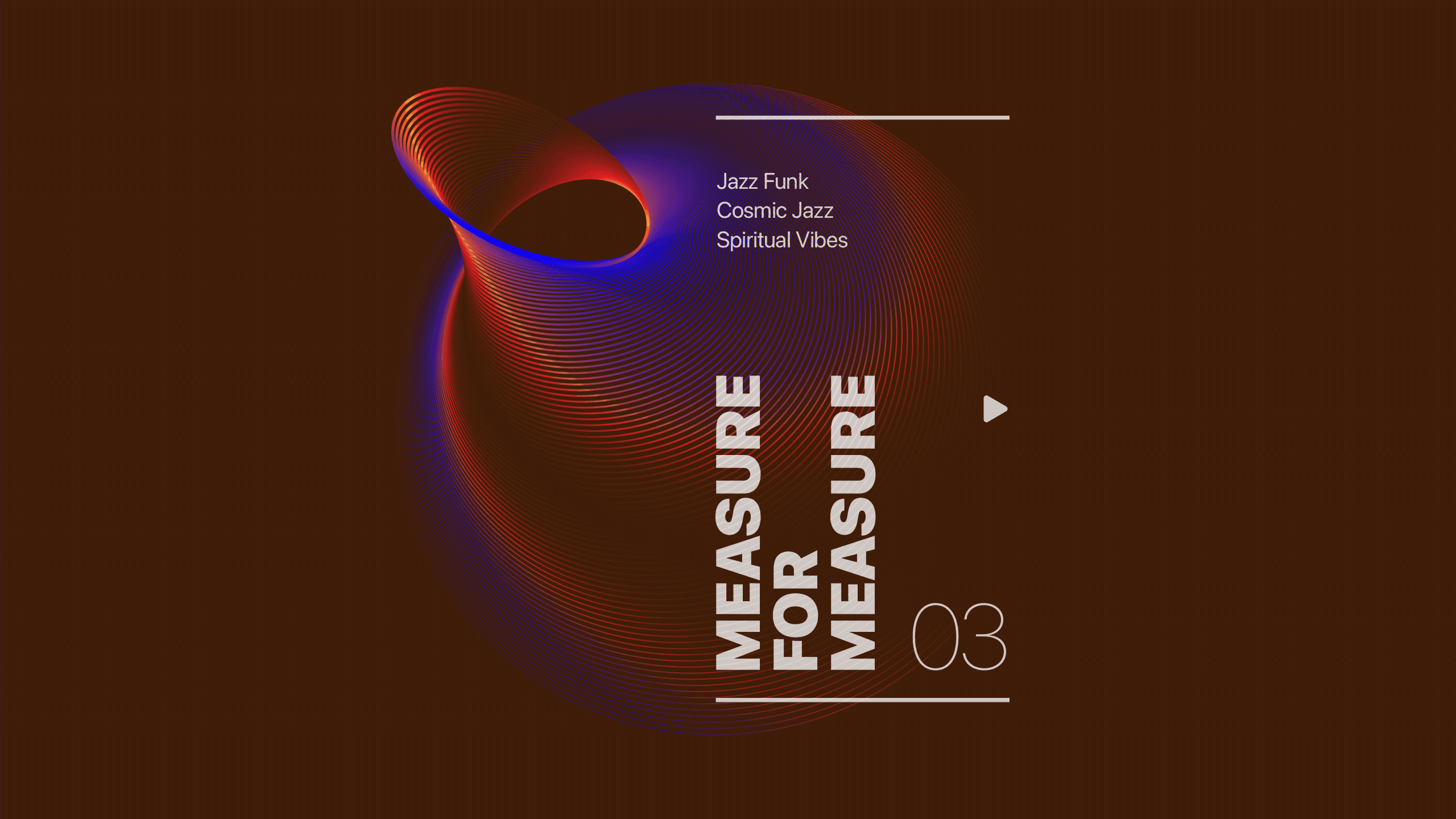
Measure for Measure | 03
"North, East, South, West" - Kool & The Gang
"Soul Vibrations (Alt. Take)" - Dorothy Ashby
"燃焼そして昇華 (Mark Wayward Edit)" - Genshu Hanayagi Mickie Yoshino Group
"Tibetian Serenity" - Travis Biggs
"Space Lady" - Lonnie Liston Smith & The Cosmic Echoes
"Summer Breeze" - Ramsey Lewis
"Ain't No Sunshine" - Bobbi Humphrey
"Asadoya Yunta" - Kifu Mitsuhashi & Kiyoshi Yamaya
"The World Is a Ghetto (J.Rocc Edit)" — Ahmad Jamal
"Swamp Fever" — John Cameron
"Insidieusement Les Elfes" - Vincent Geminiani
"Serena E Lomunno" - Riz Ortolani
"Say What" - Idris Muhammad
"Let There Be Funk" - Patrice Rushen
"Konald Byrd Lansana (Kon Remix)" - Donald Byrd
"North, East, South, West" — Kool & The Gang
Our opener "North, East, South, West" is from side A of Good Times, Kool & The Gang's third studio LP, released in November 1972 on De-Lite Records and recorded at New York's Media Sound Studios, the converted Baptist church on West 57th Street where Eumir Deodato also cut his Grammy-winning "Also Sprach Zarathustra" that same year. The album reached No. 34 on the Billboard R&B Albums chart, catching the Jersey City band in transition between an earlier jazzier instrumental run and the pop-funk crossover that 1973's Wild and Peaceful would deliver. The track is unusual in the early Kool & The Gang catalog for parking the horns and letting Robert "Kool" Bell's bass and Ronald Bell's organ carry the groove, with Claydes Smith on guitar and George Brown holding the pocket. Its longest cultural afterlife came in 1989, when DJ Mark the 45 King chopped both this cut and "Making Merry Music" from the same LP into the beat for Gang Starr's "Knowledge," a Damo D-Ski feature on the duo's Wild Pitch debut No More Mr. Nice Guy. Madlib later flipped the loop for Quasimoto's The Unseen.
"Soul Vibrations (Alt. Take)" — Dorothy Ashby
"Soul Vibrations" originally opened Afro-Harping, Dorothy Ashby's 1968 Cadet LP cut at Chess's Ter-Mar Studios in Chicago that February, the first of three records the Detroit-born harpist made with arranger-producer Richard Evans, whose stated brief at the label was to make things "very Black, very funky." The alternate take is exclusive to the Afro-Harping (Deluxe Edition) on UMR/Verve, issued September 27, 2024 with eight previously unheard passes from the surviving four-track session reels and the whole program remastered from the original quarter-inch tapes by Alex Wharton at Abbey Road, the bonus cuts left with traces of Ashby and Evans's between-take chatter still on the reel. The original's longest hip-hop afterlife came in 1995, when RZA looped it for GZA's "Killah Hills 10304" on Liquid Swords. Ashby's later session work carried her onto Stevie Wonder's Songs in the Key of Life, where her harp anchors "If It's Magic."
"燃焼そして昇華 (Mark Wayward Edit)" — Genshu Hanayagi & Mickie Yoshino Group
The original "燃焼そして昇華" (translated as "Combustion and Sublimation") appears on 残・曽根崎心中 (Zan-Sonezakishinju), the 1975 Nippon Columbia LP credited to the Mickie Yoshino Group with Hanayagi Genshu and titled after Chikamatsu Monzaemon's 1703 puppet play Sonezaki Shinjū ("The Love Suicides at Sonezaki"), one of the foundational works of Japanese Bunraku theatre. Yoshino, a Berklee graduate (1974) and former member of The Golden Cups, would rebrand his ensemble as Godiego later that same year, scoring UK chart hits including "The Water Margin" (No. 16) before the decade was out. Hanayagi was a celebrated avant-garde dancer and feminist provocateur who publicly denounced Emperor Hirohito as a war criminal and was the subject of Kim Longinotto's 1989 documentary Eat the Kimono. The album lived a quiet collector's afterlife for decades until selectors began circulating its grooves; the Mark Wayward Edit appeared in 2022, with the editor candid that the original groove only ran about a minute, which is why he extended it.
"Tibetian Serenity" — Travis Biggs
"Tibetian Serenity" originally appeared on Travis Biggs's self-funded 1976 LP Challenge (TB&C), where it ran 4:13 without spoken intro, before resurfacing in an extended 5:23 version on his 1979 Solar Funk (Source/MCA), the latter adding the soothing opening monologue. The Detroit-area multi-instrumentalist worked alongside Isaac Hayes during Hayes's late-'70s disco-curious phase and produced and arranged both of his own LPs, performing across acoustic and electric violin (including Barcus-Berry and Violectra baritone), Fender Rhodes, synthesizer, mandolin, and harp. Both records circulated mainly through soul-collector networks for decades. The track became a sample-era staple after appearing on the vinyl-edit series Dusty Fingers Vol. 6, then drew its most-cited hip-hop reuse when J Dilla looped it for **"**Jay Dee 39" on the posthumous King of Beats, Vol. 2: Lost Scrolls. UK label Demon Music Group cleaned the cut up for a 2023 "Tibetian Serenity / Autumn Jewel / After The Storm" 12-inch.
"Space Lady" — Lonnie Liston Smith & The Cosmic Echoes
"Space Lady" appears on Renaissance, the sixth and final studio album by Lonnie Liston Smith and the Cosmic Echoes, released in 1976 on RCA Victor (catalog APL1-1822). It was the only Cosmic Echoes record issued on RCA Victor proper rather than Bob Thiele's RCA-distributed Flying Dutchman imprint, and it received little promotional push, falling out of print on vinyl for decades until a BGP reissue brought it back. Produced by Thiele and Smith and arranged by Horace Ott, the session pulled in Smith's brother Donald on flute and vocals, David Hubbard on flute and reeds, Gene Bertoncini on acoustic guitar, Leon Pendarvis on clavinet, and Ken Bichel on Moog. The track has been sampled across more than twenty later records, most prominently Da Lench Mob's "Ankle Blues" (1992, produced by Ice Cube and his team) and Soul II Soul vocalist Caron Wheeler's solo "Blue (Is the Color of Pain)" (1990). Smith's broader hip-hop afterlife included a feature on Guru's Jazzmatazz Vol. 1 (1993).
"Summer Breeze" — Ramsey Lewis
Ramsey Lewis's reading of Seals & Crofts's 1972 anthem "Summer Breeze" sits on side A of Solar Wind, his 1974 Columbia LP recorded between CBS Recording Studios in Chicago and Steve Cropper's Trans Maximus Sound in Memphis, with Cropper producing the Memphis sessions and Lewis co-producing the Chicago dates alongside longtime bassist Cleveland Eaton II. The album peaked at No. 29 on Billboard's Top Jazz LPs chart. Lewis stretched the harmony-rock original into a synth-streaked funk workout, with James L. Hersen's Moog floating above Eaton's prowling upright bass and Morris Jennings's pocket. Hip-hop has returned to that pocket repeatedly: Jurassic 5 lifted a single bar for "Concrete Schoolyard" in 1998, and producer Inflo built Little Simz's "Gorilla" (Forever Living Originals, 2022) around the same passage, the same Inflo who shaped Cleo Sol's Strictly Butter | 02 selection. Lewis died in 2022, having recorded for nearly seven decades.
"Ain't No Sunshine" — Bobbi Humphrey
Bobbi Humphrey's "Ain't No Sunshine" opens her debut LP Flute-In, recorded at Van Gelder Recording Studios on September 30 and October 1, 1971 and released that year on Blue Note Records, the label she joined as the first African-American female instrumentalist signed there as a leader, opening a path that would carry through to her mid-1970s commercial peak with the Larry and Fonce Mizell-produced LPs Blacks and Blues (1973), Satin Doll (1974), and Fancy Dancer (1975). Bill Withers's original had landed earlier the same year on his Sussex debut Just As I Am, and Humphrey's cover was cut while the song was still climbing the charts. Producer George Butler and arranger Wade Marcus assembled a lineup that included Hank Jones on piano, Gene Bertoncini on guitar, and Idris Muhammad on drums for this specific track, all engineered by Rudy Van Gelder. Five years later, Humphrey joined Stevie Wonder on "Another Star" from Songs in the Key of Life, the same record where Dorothy Ashby's harp anchors "If It's Magic." Atban Klann, the pre-Black Eyed Peas Eazy-E project on Ruthless, sampled this recording for "La Borio Woman Beater" in 1992.
"Asadoya Yunta" — Kifu Mitsuhashi & Kiyoshi Yamaya
This version of "Asadoya Yunta" was recorded in March 1976 at Nippon Columbia Studios in Tokyo and originally appeared on Shakuhachi: The Ballads of the Village, where shakuhachi master Kifu Mitsuhashi was framed by arranger Kiyoshi Yamaya's Contemporary Sound Orchestra. The recording was rescued for crate-digger circulation by Wamono Groove: Shakuhachi & Koto Jazz Funk '76, the fourth release in Paris-based 180g's Wamono series, released January 28, 2022 on 180-gram heavy vinyl, licensed directly from Nippon Columbia, and mastered at Timmion Cutting Lab in Helsinki. The underlying song carries cultural weight. "Asadoya Yunta" is a centuries-old Ryukyuan yunta from Taketomi Island in Okinawa's Yaeyama district, traditionally sung as call-and-response field labor and built around the story of Asato Kuyama (1722–1799), who, in the Okinawa-popular version, rebuffs a marriage proposal from a Ryukyuan official, the song carrying an anti-authority undercurrent rooted in the period when the Ryukyu Kingdom was a heavily taxed tributary state of feudal Japan. Mitsuhashi was awarded the Order of the Rising Sun in 2020. Yamaya's mid-1970s panoramic LPs for Columbia and Denon mapped jazz-funk rhythm sections onto shakuhachi, koto, biwa, and shamisen, a marriage of traditions that has only grown more compelling with distance.
"The World Is a Ghetto (J.Rocc Edit)" — Ahmad Jamal
The source recording opens Ahmad Jamal '73, released in 1973 on 20th Century Records and produced by Jamal with arranger-conductor Richard Evans (the same Chicago-based collaborator who shaped Dorothy Ashby's Afro-Harping earlier in this mix). It was the only all-electric record in Jamal's discography, with the pianist working entirely on Fender Rhodes; a contemporary 20th Century trade ad framed the pivot with the headline "Ahmad Jamal Trips Out." His nine-minute reading of War's 1972 R&B No. 1 anthem "The World Is a Ghetto" quietly interpolates his own 1958 Argo trio reading of "Poinciana," the recording that had built his career, recasting both compositions in a single gesture. Jamal himself appears to have resented the period and prevented his 20th Century catalog from being reissued during his lifetime; a Big Pink CD finally arrived in 2024, eighteen months after his April 2023 death and sourced from clean vinyl since Universal's masters were almost certainly destroyed in the 2008 vault fire. J. Rocc's edit appears as track 14 on his 2010 unofficial mixtape Syndromes 2, a vinyl-collector survey nestling Jamal's Rhodes meditation alongside Phil Ranelin, Junior Mance, and Dorothy Ashby.
"Swamp Fever" — John Cameron
"Swamp Fever" sits on side B of Afro Rock, the 1973 KPM Music library LP credited jointly to British composers Alan Parker and John Cameron and now considered one of the catalog's most-cited grooves. Library records were not sold in stores; KPM 1000 Series pressings circulated directly to film and broadcast production houses under blanket licensing, which is precisely why composers like Cameron worked so freely inside the format. Cameron's actual life is a remarkable arc: educated at Corpus Christi College, Cambridge, where he served as Vice-President of the Footlights and wrote lyrics with Eric Idle, his first arrangement job after leaving was Donovan's "Sunshine Superman," which went to No. 1 in the U.S. in September 1966. That single launched a career that would include the score for Ken Loach's Kes, arrangement work for Cilla Black, Hot Chocolate, and Heatwave, and the CCS instrumental cover of Led Zeppelin's "Whole Lotta Love" that served as the BBC's Top of the Pops theme from 1970 to 1981. The track was officially released to the public for the first time on Strut Records' Music for Dancefloors: The KPM Music Library, with Afro Rock itself returning to commercial circulation via Tummy Touch in 2007.
"Insidieusement Les Elfes" — Vincent Geminiani
"Insidieusement Les Elfes" appears on Modern Pop Percussion, the 1972 LP credited to French composer-percussionist Vincent Gémignani with the Ensemble de Percussion de Paris and released on the Concert Hall imprint, with material from the same 1970 sessions also issued under the alternate title Musique Pour Un Voyage Extraordinaire on Musique Pour l'Image. The session had been written to score a stage play, which is part of why the record sits across such an unusual stylistic seam, blending European avant-garde percussion, jazz-funk rhythm-section underpinnings, and concrete sound design. Gémignani, born in 1939 to a sculptor father and a musician mother, founded the Ensemble de Percussion de Paris in 1959 and pursued a parallel career as a sculptor. The two practices eventually fused when he invented an instrument he called the bronté, from the Greek for thunder: an alpaca-alloy keyboard struck with mallets or bowed and amplified through a metallic dome resonator he designed himself. The bronté threads through the album, opening unfamiliar timbres inside grooves otherwise rooted in the period library-music vocabulary. The track was anthologized on The Library Music Film: Music From and Inspired By the Film in 2018, the vinyl-only compilation accompanying producer Shawn Lee's documentary travelogue through the European library-music vaults.
"Serena E Lomunno" — Riz Ortolani
"Serena E Lomunno" is one of the cues Riz Ortolani composed for Damiano Damiani's 1971 Confessione di un Commissario di Polizia al Procuratore della Repubblica (released internationally as Confessions of a Police Captain), the Sicilian mafia thriller starring Martin Balsam and Franco Nero that won the Grand Prix at the 1971 Moscow International Film Festival and finished as the eleventh-highest-grossing Italian film of the 1970–71 season. Ortolani (1926–2014), born in Pesaro and one of the foundational figures of postwar Italian film music alongside Morricone, Umiliani, and Trovajoli, had broken through internationally in 1962 with the theme **"**More" from Mondo Cane, which won him a Grammy and earned an Oscar nomination. He would later score Ruggero Deodato's Cannibal Holocaust (1980), a film whose tonal contrast between Ortolani's lyricism and Deodato's content remains one of cinema's strangest mismatches. The cue is named for two of the film's central characters, Serena Li Puma (Marilù Tolo) and Ferdinando Lomunno (Claudio Gora). Italian soundtrack specialists Four Flies Records issued the score in expanded form in 2018 and returned in 2024 with a limited 500-copy 7-inch pairing the cue with another piece from the score.
"Say What" — Idris Muhammad
"Say What" closes Turn This Mutha Out, Idris Muhammad's 1977 Kudo LP, recorded at Mediasound and Electric Lady, and produced and arranged by David Matthews. It was one of the few Kudu titles not produced by Creed Taylor himself. The session lineup is a who's-who of New York's late-seventies studio elite: Wilbur Bascomb on bass, Hiram Bullock and Charlie Brown on guitars, Michael Brecker on tenor sax, Randy Brecker and Jon Faddis on trumpets, with Muhammad's New Orleans-born drum vocabulary anchoring everything. The album sat inside Kudu's mid-seventies pivot toward crossover R&B and disco, a move that drew critical disapproval at the time (the Bay State Banner accused Muhammad of having "succumbed to the lure of money via the disco sound"). The accusation aged poorly. Fifteen years later Erick Sermon and Parrish Smith built EPMD's "Crossover," a No. 1 hip-hop single from Business Never Personal (Def Jam, 1992), around "Say What"'s opening, with lyrics critiquing rappers selling out to radio, an irony given the source. LL Cool J (Jealous," 1989) and Nas ("Dr. Knockboot," 1999) flipped the record across the same era. Muhammad's drumming earlier on this very mix anchors Bobbi Humphrey's "Ain't No Sunshine" from 1971.
"Let There Be Funk" — Patrice Rushen
"Let There Be Funk" sits on side B of Shout It Out, Patrice Rushen's third and final Prestige LP, released in February 1977 and produced by Rushen with Reggie Andrews and Tommy Vicari, with Orrin Keepnews as executive producer and Bernie Grundman handling mastering. The session band included Al McKay on guitar (still a member of Earth, Wind & Fire at the time), Charles Meeks on bass, James Gadson on drums, and Bill Summers on percussion. Rushen, born in Los Angeles in 1954, had been identified as a prodigy at age three and enrolled at USC's early-childhood music education program at four. She signed to Prestige at seventeen after winning a Monterey Jazz Festival solo competition, recording all three Prestige LPs while still an undergraduate. The shift toward funk and R&B writing on this record drew dismissal from jazz purists at the time, the same charge that later attached to her 1982 R&B hit "Forget Me Nots," the song Will Smith later used as the harmonic skeleton of the Men in Black theme. Three years after the original release, Prestige issued the compilation Let There Be Funk: The Best of Patrice Rushen (1980), taking its title from this cut. Rushen was named a 2026 NEA Jazz Master.
"Konald Byrd Lansana (Kon Remix)" — Donald Byrd
The source for Kon's beautiful remix is "Lansana's Priestess," the seven-and-a-half-minute opener of Donald Byrd's Street Lady, released on Blue Note in July 1973 and produced, arranged, and composed throughout by Larry Mizell, who along with brother Fonce had been Byrd's students at Howard University, where Byrd chaired the Black Music Department. The Mizells' previous collaboration with Byrd, Black Byrd (1972), had become the biggest seller in Blue Note's history. Larry Mizell, in parallel to his music career, was an electrical engineer who performed reliability work on the Lunar Module for NASA's Apollo program. The session band stacked Sky High Productions' regular Los Angeles lineup: David T. Walker on guitar, Chuck Rainey on bass, Harvey Mason on drums, Jerry Peters on Fender Rhodes, Freddie Perren on ARP synthesizer, the same nucleus that would shape Bobbi Humphrey's Blacks and Blues months later. Boston DJ-producer Kon, half of the Kon & Amir duo whose On Track and Off Track compilations Gilles Peterson called "very much ahead of the curve," posted the remix to SoundCloud in February 2013 as a tribute days after Byrd's death at 80, with the upload thanking the trumpeter "for your music and your gift."
Listen to: Measure for Measure | 01