Title
Category
DJ Mixes
DJ
Year
Turn Sound On
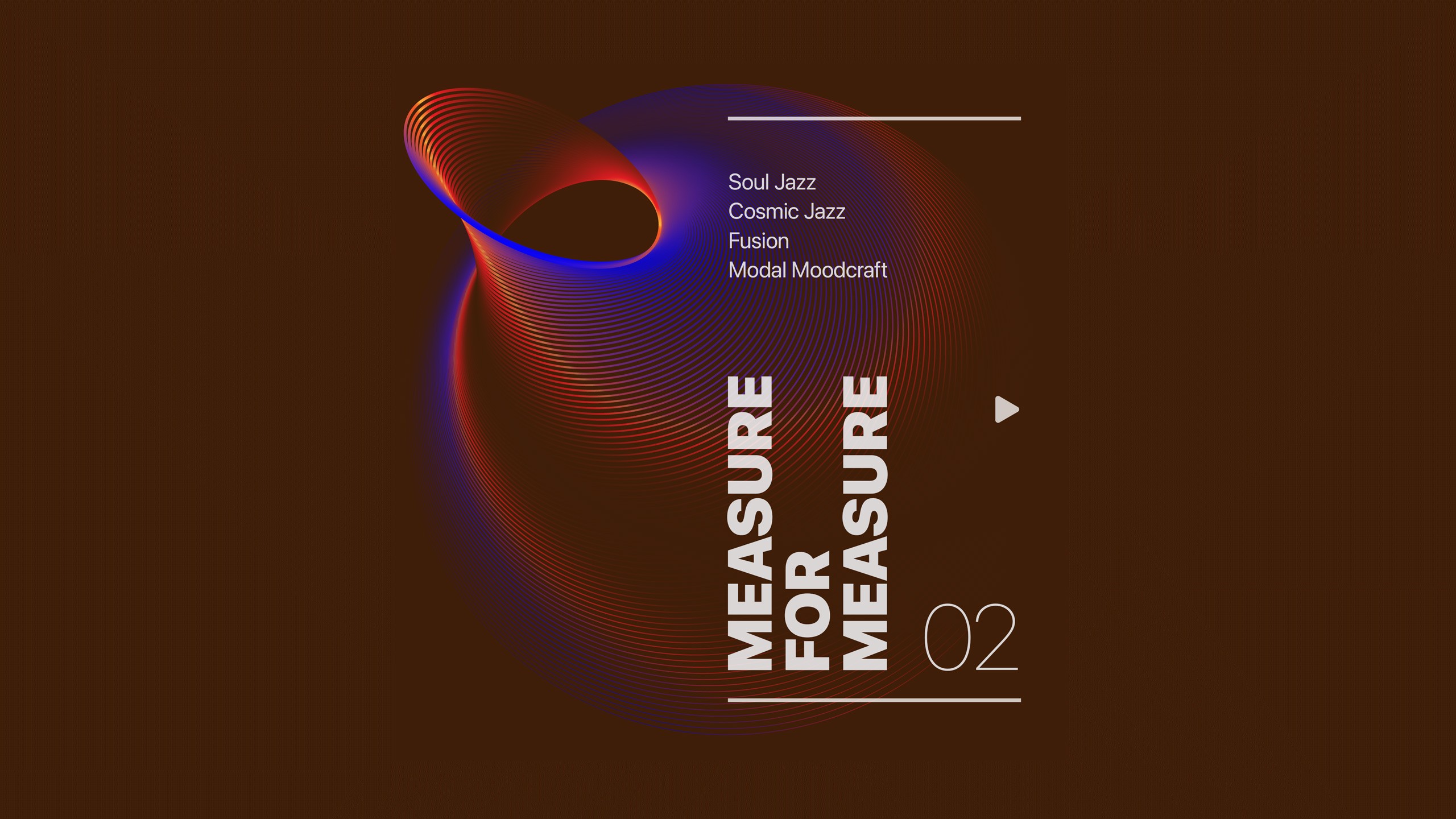
Measure for Measure | 02
"Munmorah" - Triosk Meets Jan Jelinek
"Vibes From The Tribe (J-Rocc Edit)" - Phil Ranelin
“The Plum Blossom" - Yusef Lateef
"We Walk" - Hu Vibrational
"NTU" - Bobby Hutcherson
"Never Can Say Goodbye" - INO Hidefumi
"Reflections" - Bill Conti
"Shades of Blue" - Esbe
“Hummin’ In The Sun (Black Monk Remix)" - Roy Ayers
"Reflection" - Emapea
"At This Point In My Life (DJ Jazz Instrumental)" - Tracy Chapman
"Variance" - Aether
"I've Known Rivers (Madlib Remix)" - Gary Bartz
"Loving You" - George Otsuka Quintet
"Munmorah" - Triosk Meets Jan Jelinek
Ample headspace, restrained beats, and jazz loop electronica propel this opener. Jelinek sent loop material from Berlin to Sydney, where Triosk (drummer Laurence Pike, pianist Adrian Klumpes, bassist Ben Waples) improvised over the source fragments at Megaphon Studios before the tapes traveled back to Berlin for Jelinek's editing, mixing, and mastering. That back-and-forth gave the album its title: 1+3+1, originally issued in 2003 on Stefan Betke's ~scape imprint and reintroduced on vinyl by Jelinek's own Faitiche label in 2021. The Munmorah loops draw from material on Jelinek's earlier "en/of 004" EP under his ICE Compositions alias, with Pike's cymbal work and Klumpes's Fender Rhodes floating over the click-and-pop substrate.
"Vibes From The Tribe (J-Rocc Edit)" - Phil Ranelin
Phil Ranelin co-founded Detroit's Tribe Records with Wendell Harrison, a musician-run imprint and magazine that linked community politics to spiritual jazz. "Vibes From The Tribe" is one of the label's signature themes, returned to circulation by Now-Again in a definitive reissue lacquered from the original tapes by Bernie Grundman, with a booklet by Larry Gabriel and Jeff "Chairman" Mao tracing the Tribe story. Trombone over trimmed breaks with bass and hand percussion. The J-Rocc edit nods to the Beat Junkies founder's longstanding habit of opening crate-digger DJ tapes with Tribe sides, a theme since the original "Syndromes" cassette in the mid-1990s.
"The Plum Blossom" - Yusef Lateef
Recorded at Rudy Van Gelder's Englewood Cliffs studio on September 5, 1961 and issued on Prestige's Moodsville imprint, "The Plum Blossom" opened Eastern Sounds with Lateef on the Chinese xun, a globular clay flute he'd found on a shopping trip through New York's Chinatown after reading about it in a book on Chinese music. Barry Harris on piano and Ernie Farrow's plucked rabab (a Central Asian lute), frame Lateef's lifelong investigation of non-Western instruments.
"We Walk" - Hu Vibrational
Adam Rudolph's Hu Vibrational issued "We Walk" on the 2004 album Beautiful (Boonghee Music 2), pairing meditative percussion with low end bass. Sessions ran at Groovetree Recording in Mar Vista, California in May 2002, with mixes finalized that June at Portrait Of The Artist in Santa Monica by Carlos Niño and Daedelus. Released by Soul Jazz as part of a brief Afro-percussion and electronics arc. Track dedications to Don Cherry and Yusef Lateef signal Rudolph's method: ritual polyrhythms, modal tones, and studio dubs, with Hamid Drake on trap drums alongside Rudolph's dusu'ngoni, udu drums, and kalimbas.
"NTU" - Bobby Hutcherson
"NTU" closes side A of Linger Lane, recorded outdoors on January 16, 1975 in Idyllwild, California and released later that year on Blue Note. Hutcherson sets the vibes aside for the entire session and plays marimba, joined by Ernie Watts on reeds, Jerry Peters on Fender Rhodes, Chuck Rainey on bass, Harvey Mason on drums, and Bobbye Hall on percussion. The title is an Akan term associated with universal force or spirit, and the track is widely understood as a nod to Gary Bartz's NTU Troop, placing Hutcherson's hypnotic guitar ostinato and improvised marimba in the same Black consciousness orbit as Lonnie Liston Smith and Bartz himself. The album sat out of fashion for decades; the cut now reads as one of the underrated entries in his 1970s catalog.
"Never Can Say Goodbye" - INO Hidefumi
INO Hidefumi's instrumental cover of "Never Can Say Goodbye" closes Satisfaction, his 2006 debut on his own Innocent Record imprint (a label named by Yasuharu Konishi of Pizzicato Five). All instruments played by INO Hidefumi from his Ebisu cafe-studio Tenement, leaning into dubby future jazz: a satin-smooth, Rhodes-driven take on the Jackson 5's 1971 Clifton Davis composition, produced originally by Hal Davis for the Maybe Tomorrow LP.
"Reflections" - Bill Conti
A familiar move from cratediggers: Conti's "Reflections" is buried on the Rocky original motion picture score from 1976, the same album that gave us "Gonna Fly Now." Stripped of the boxing-anthem context, the cue is melody-driven jazz-fusion with strings, electric piano, and understated rhythm, and it borrows openly from Kool & the Gang's "Summer Madness." The track has been sampled by more than ten hip-hop producers over the decades.
"Shades of Blue" - Esbe
Cold Busted pulled the Los Angeles producer Esbe into its ecosystem, a label world of lo-fi jazz chords and boom-bap tempo. "Shades of Blue" opens the May 2015 Bust Free 18, fixing the title in the Portland-based label's long-running compilation series and introducing Esbe to a global downbeat audience. The track's palette of dusty keys, upright bass, and rim-shot drums slots neatly alongside Emapea and the label's other producers, where short-form instrumentals get produced like 7-inch B-sides.
"Hummin' In The Sun (Black Monk Remix)" - Roy Ayers
Listed as a Roy Ayers cut because that is where its DNA lives: this is producer Chris Cole, working as Black Monk, building the track around a sample of Ayers's 1971 cut "Hummin'" from his Polydor debut Ubiquity (originally a Nat Adderley and Gene McDaniels composition, arranged by Ayers and Edwin Birdsong). The track sits on the Day & Night EP, released in 2005 on the Pasadena imprint Poo-Bah Records, which Cole co-founded with Ras G and Ron Stivers, kicking off the LA beat-scene chapter Stones Throw and Brainfeeder would later expand on. A sun-baked instrumental, the sample drifting through an SP-1200.
"Reflection" - Emapea
From the Polish beatmaker P. Borucki's compilation Reflection, released in December 2020 on Cold Busted, the title cut threads library-grade keys and hazy drum programming with acoustic sourcing. (The track first appeared on the September 2015 Bust Free 19 before being pulled together with seven others for this inside-out vinyl edition.) Compact jazz phrasing gets filtered and framed, snare and dry kick balanced by the roomy bass.
"At This Point In My Life (DJ Jazz Instrumental)" - Tracy Chapman
A vocal-chopping rework of Chapman's slow-burn ballad from her 1995 album New Beginning, originally produced by Don Gehman and Chapman for Elektra. The DJ Jazz instrumental is the work of a Zagreb-based selector and circulates online only, a quiet downtempo edit that lets the piano carry the melody between phrases while Chapman's vocal supplies pathos and harmonic gravity.
"Variance" - Aether
From Artifacts, released in November 2008 on the San Antonio independent Exponential Records, "Variance" distills late-2000s beatmaker instincts with classical string tones and an unmistakable melodic source: the cut is built around Ryuichi Sakamoto's 1996 ballad "Bibo No Aozora," situating the beat in a contemporary-classical ambient jazz lineage. Producer Diego Chavez, who also records as A.M. Architect and Otic Angst, drew comparisons on release to DJ Shadow and Prefuse 73; transients are soft, with passages suspended amid the cinematic scale.
"I've Known Rivers (Madlib Remix)" - Gary Bartz
Bartz's spiritual-jazz theme, indebted to Langston Hughes's 1921 poem "The Negro Speaks of Rivers," is a live July 1973 highlight from I've Known Rivers and Other Bodies, recorded at Montreux with the NTU Troop of Hubert Eaves (piano), Stafford James (bass), and seventeen-year-old Howard King (drums). A DJ pleasure for years, the Madlib remix is part of Otis Jackson Jr.'s habit of folding spiritual jazz into hip-hop architecture. Madlib's hand drumming frames the heavy pulse while the vocal floats.
"Loving You" - George Otsuka Quintet
Recorded live at the Nemu Jazz Inn on July 19, 1975 and originally issued on the cult Japanese imprint Bellwood (also home to Haruomi Hosono's Hosono House), "Loving You" is Otsuka's Minnie Riperton cover rendered as modal jazz spirit funk, with Fumio Karashima's Fender Rhodes in the foreground and room for Otsuka's cymbal time. Wewantsounds restored the tapes through King Records and reintroduced the LP to wider ears in 2021. A soulful beauty for the evening's climax.
Listen to: Measure for Measure | 03